
 Benjamin Otu Effiwatt
Not all abuse comes screaming from the rooftops. Sometimes it arrives quietly—in the form of slow erosion, through relationship patterns that repeat over time and gradually wear you down.You don’t realize you’re being broken because it doesn’t happen all at once. You become tired. Burnt out. Numb. You wonder why you suddenly hate yourself. You forget who you are outside of them.
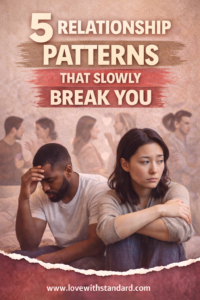
If you’ve ever been in a relationship that made you feel smaller than you are, you might be familiar with these 5 Relationship Patterns That Slowly Break You.I’m not suggesting that every couple who argues or has disagreements falls into these patterns. But I do know that if these habits are ongoing in your relationship, they will change you.

1. Emotional Invalidation That Makes You Question Your Reality
Of all the patterns on this list, emotional invalidation destroys your sense of self the fastest.
Why? Because every time you’re emotionally invalidated, you begin to question your reality.
“You’re too sensitive.”
“That didn’t hurt your feelings.”
“That didn’t happen.”
“You always freak out over nothing!”
Sound familiar? If you’ve been with someone long enough, chances are these phrases have left the lips of someone you loved.
Repeated emotional invalidation conditions you to distrust yourself. You start questioning whether you really feel the way you say you feel. Am I overreacting? Am I too sensitive? Did that really happen?
You stop voicing things that matter to you—not because they don’t matter, but because you’ve been told your emotions are never valid.
Slowly, your inner voice becomes quieter. You stop trusting your needs. You accept the message that something feeling “off” is normal. And you begin to believe you don’t deserve to feel safe.
You don’t just learn to question them—you learn to question yourself.
2. Love That Feels Conditional Based on Your Behavior
Do you feel more loved when your partner is happy with you? And does your partner pull away when you’re upset, set a boundary, or say no?
When love is conditional, affection is constantly used as currency.
You give them compliments so they’ll smile at you.
You stay quiet even when they hurt you so they won’t leave.
You change your mind so they can be happy.
“You’re only loved as much as you are able to please the other person.”
You learn to perform love. Don’t rock the boat. Stay agreeable. Don’t make your partner upset.
Before long, love stops feeling safe. It becomes something you constantly have to earn by behaving a certain way.
3. Taking On More Emotional Labor Than They Do
Someone once told me that staying in a relationship too long was like dating your best friend who happened to live in your house.
Let me tell you how much that cracked me up when I was in a one-sided relationship.
My partner did everything. Remembered birthdays. Paid the bills. Planned dates. Checked in on me. Took care of the dog. You name it—he did it.
At first, I enjoyed it. Being taken care of felt cute. Like love.
But it didn’t take long before I realized I was doing all of the emotional labor.
I was the only one:
-
Checking in on how they were feeling
-
Making sure they knew I cared
-
Texting them and waiting anxiously for a response
-
Giving them space when all I wanted was to talk
-
Asking how they were and offering support when they struggled
But the moment I ever tried to ask for the same, I was met with:
“You always care more about my feelings than I do yours.”
“Don’t stress about it. Men don’t think about these things.”
“I just don’t feel the same way.”
Suddenly, my feelings were invalid. My needs were “too much.” I was being “too needy.”
When you grow up in a culture that conditions girls to be good caregivers, it’s easy to find yourself in relationships where you give too much of yourself.
You give them your heart.
You give them your time.
You give them your attention.
You listen to their problems.
But who’s listening to yours?
4. Slow Boundary Erosion That Allows Them to Cross Your Limits
As humans, we all have limits—things we will and won’t tolerate in relationships.
Healthy boundaries aren’t always rigid. There will be times when compromise is necessary.
The problem starts when giving becomes a pattern.
You let them stay over and do something you said you hated.
You don’t call them out when they say something hurtful.
You stop talking for days after an argument “because they’re probably over it by now.”
These moments may not seem like a big deal on their own. But what happens when they start piling up?
Over time, your boundaries begin to fade.
You lose your sense of limits. You take responsibility for their feelings. You allow them to treat you in ways you once swore you never would.
You feel off—but you can’t explain why.
This happens because you slowly teach someone that crossing your boundaries has little to no consequence.
Healthy people won’t disrespect your boundaries—even if you stumble while enforcing them.

5. Hanging Onto Hope Instead of Letting Go When There’s None Left
This may be the pattern that keeps people stuck the longest.
They stay not because it’s good—but because it could be.
They focus on who their partner was in the beginning. Who they promise to become. The rare moments they show up. The version of the relationship that might exist if they tried.
But living in “what if” hurts just as much as living in reality.
You stay even though they:
-
Show up only when it’s convenient
-
Ignore your needs most of the time
-
Don’t make you a priority
-
Brush off your feelings
-
Make you question your reality
You stay because your presence is rooted in hope.
Hope that one day they’ll treat you how you deserve.
Hope that they’ll change.
Hope that maybe you’re the problem.
And before you realize it, you’re too tired—and too hopeless—to love yourself.
Why These Patterns Are Toxic (And Why You Didn’t See Them Coming)
Do you notice the trend in all of these patterns?
Every single one can stem from affection.
When someone you love hurts you emotionally, it’s hard to accept that they’re slowly destroying you.
You tell yourself:
“This is just how they show love.”
“Everyone argues sometimes.”
“If they really loved me, they wouldn’t make me feel this way.”
That’s why these patterns are so toxic—they cloud your judgment.
You cry to your mom about how much they hurt you, and she says you two can work it out.
You convince yourself that you just need to communicate better.
You stay quiet instead of speaking up because you think if they loved you, they should understand without you having to explain everything perfectly.
Your love for them becomes the sharpest weapon against yourself.
How These Patterns Will Change You Over Time
Beyond damaging your sense of self, these patterns condition you to:
-
Have less self-confidence
-
Fear expressing your needs
-
Avoid conflict at all costs
-
Doubt every disagreement
-
Feel emotionally numb
-
Sound depleted and disconnected
Eventually, you forget what you liked about yourself before them.
Maybe you stopped engaging in your hobbies because you never had time.
Maybe you drifted from friends because your partner became your main support system.
Losing yourself becomes subconscious. It’s not that you don’t love yourself—you’ve just grown accustomed to putting yourself last.

How to Stop Yourself From Breaking
You can’t repair something if you don’t know it’s broken.
Patterns are dangerous because the longer you stay in them, the easier they feel.
Awareness alone isn’t enough. You need to know what you’re willing to tolerate.
What are you willing to accept?
What feelings are you willing to ignore?
What version of yourself are you willing to become?
Once you define your boundary line, you can spot these patterns when they emerge. You can recognize unhealthy dynamics early—before they repeat.
And you can protect yourself from slowly being torn apart.
Conclusion
Relationships are meant to add to your life, not quietly dismantle it.
The most dangerous part about these patterns isn’t that they hurt—it’s that they normalize the hurt. They teach you to tolerate discomfort, dismiss your instincts, and confuse endurance with love. Over time, you stop asking whether a relationship is healthy and start asking how much more of yourself you can sacrifice to keep it alive.
But love that costs you your voice, your boundaries, or your sense of self is not sustainable love.
If you recognized yourself in any of these patterns, that awareness alone is powerful. It doesn’t mean you failed. It means your nervous system has been paying attention long before your mind caught up. The exhaustion, the numbness, the self-doubt—they’re not flaws. They’re signals.
Save pin for later

- 10 Self-Care Tips Every Woman Needs After a Toxic Relationship - March 11, 2026
- Top 10 Marriage Quotes - March 11, 2026
- 7 Reasons You Keep Going Back to Toxic Partners - March 11, 2026