

 Benjamin Otu Effiwatt
Narcissistic relationships don’t start off abusive. They start off with charm, praise, special treatment, and emotional intimacy. It may have felt exhilarating at first.
Then, slowly, things change. What was once exciting becomes muddled, hurtful, and suffocating. You may find yourself second-guessing your instincts, shrinking away when you normally would speak up, or feeling generally less confident than before.Manipulation tactics used by narcissists are purposeful. Each one aims to break down your sense of self while increasing your perceived dependence on them for validation, approval, and emotional safety.

1. Gaslighting: Making You Doubt Your Reality
Gaslighting is perhaps the most infamous tactic in the narcissistic toolbox. When you try to assert yourself or question unacceptable behavior, a narcissist may say things like:
“That never happened.”
“You’re imagining things.”
“You’re too sensitive.”
“You always…”
Gaslighting involves saying things that make you question your memory, judgment, or even your sanity.
The goal is to make you doubt yourself whenever you speak up. Until you begin trusting yourself and your experiences again, you will always fear speaking your truth.
This makes you “small” by forcing you to rely on the narcissist for your version of reality.
When you cannot trust your perception of events, it becomes nearly impossible to set boundaries or leave the relationship. Your sense of self is warped to fit what the narcissist wants you to believe.
2. Constant “Helpful” Criticism
Constructive criticism is one thing. Constant, demeaning criticism disguised as “helpful advice” is a form of manipulation.
Examples include:
“I’m only saying this because I care.”
“If you listened to me, you’d…”
“I’m just being honest…”
Insulting someone under the guise of helping them becomes a subtle form of emotional abuse. Eventually, you may begin to believe that you’re not good enough.
The narcissist implies that they’re always right while you’re floundering blindly. You become too scared or unsure to trust yourself.
You feel “small” by constantly seeking their approval and validation.
3. Withholding Love, Affection, or Approval
Have you ever felt that giving the narcissist what they wanted would result in love, affection, or approval?
When you do what they want, they may smile, laugh, and show interest. When you stand up for yourself or tell them “no,” that warmth quickly disappears.
Examples include:
-
Silent treatment
-
Being emotionally unavailable
-
Coldness or indifference
-
Suddenly acting bored or annoyed with you
The narcissist conditions you to be extremely receptive to their wants and needs. You learn to avoid upsetting them by hiding your true self.
Self-expression becomes a liability. You may begin censoring your feelings, desires, or opinions out of fear of “making them mad.”
This tactic forces you to hide who you truly are, making you shrink down into someone safe and moldable.

4. Minimizing Your Pain Through Comparison
Sharing something that upsets you may result in the narcissist minimizing your experience.
“You’re overreacting.”
“That’s not why they did that.”
“Don’t be so sensitive.”
“It wasn’t that bad.”
“Why are you still mad?”
Suddenly, your pain doesn’t matter. Someone else had it worse, or you’re blowing things out of proportion.
You quickly learn not to share your feelings with the narcissist. Over time, you stop expressing yourself altogether.
This is the dangerous side effect of shutting down your emotions. Instead of validating your inner world, the narcissist only acknowledges theirs.
They want you to feel small by convincing you that your pain is insignificant or foolish.
5. Shifting Blame and Avoiding Accountability
You would expect someone who wrongs you to apologize or accept responsibility. Healthy people do this. Narcissists do not.
They may say things like:
“If you hadn’t…, then I wouldn’t have…”
“You started it!”
“You’re the problem.”
“I can’t help it if you…”
“You always…”
They either shift blame onto you or ask you to “meet them halfway.” There will be no accountability.
As a result, you may ruminate endlessly. How could you have prevented the argument? What can you do to make it up to them?
You unknowingly remain in a constant state of self-correction and self-scrutiny. There is no room for personal growth because the narcissist will not acknowledge their wrongdoing.
6. Isolation From Other Support Systems
The narcissist wants to be your everything. But is that healthy or realistic?
If someone else understands you, offers sound advice, or becomes your primary source of support, the narcissist may feel threatened.
They may subtly—or not so subtly—pick apart your other relationships. Over time, you may feel more comfortable confiding in them alone.
Without other perspectives, the narcissist’s voice and version of events become all-encompassing. You become dependent on them for your emotional needs.
Codependency is an effective tool for keeping you small and confined to the relationship.

7. Moving the Goalposts
Narcissists are never satisfied. No matter what you do, it will never be enough.
You may receive compliments one moment and criticism the next. What was acceptable yesterday may earn disapproval today.
There will always be a new goal or expectation to meet to keep them happy. You may feel like you are constantly disappointing them.
You shrink yourself trying to please someone who can never be pleased.
Why Do Narcissists Use These Tactics?
These tactics are damaging and confusing. You may wonder why someone you love would manipulate you so intentionally.
Abuse of any kind is harmful, and there is no excuse for it. Still, you may be curious why these behaviors are so effective at wearing you down.
Narcissists use these tactics because they prey on your empathy, loyalty, and hope. They know you care and want to help.
Many people remain in abusive relationships because they cherish good memories, believe the abuser will change, or feel responsible for fixing the relationship.
None of this is your fault. But it does explain why someone you love may manipulate you into staying.
How Do These Tactics Keep You Small?
When you constantly question your instincts, lose confidence, or fear confrontation, you become small.
You begin censoring parts of yourself to keep the peace or avoid upsetting them. Over time, pieces of your identity are stripped away.
You may start to feel like:
-
You don’t know who you are without them
-
You can’t trust your instincts
-
Everything you say or do is wrong
-
You’re too sensitive
You may even feel undeserving of genuine love and kindness.

How to Reclaim Your Power and Worth
None of these feelings are your fault. You were manipulated into loving and trusting someone who intentionally broke your spirit.
Healing begins with awareness. Recognizing that these tactics are real and happening to you is the first step toward reclaiming your power.
If these behaviors feel familiar, you can begin separating your truth from the narcissist’s narrative by:
-
Reconnecting with your feelings
-
Validating your thoughts and experiences
-
Trusting yourself again
-
Seeking healthy relationships
-
Setting boundaries, even when it feels scary
-
Allowing yourself to grieve the relationship you wished you had
You are allowed to feel your feelings. You are allowed to ask for help. You do not need to earn someone’s love by staying small.
Final Thoughts
Narcissistic manipulation is powerful because victims are often kept in the dark. If you don’t know what’s happening, how can you fight back?
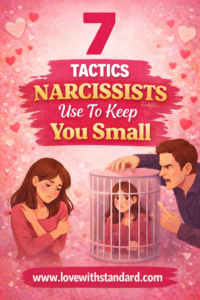
Now you know The 7 Tactics Narcissists Use To Keep You Small. With this knowledge, you can begin setting boundaries and advocating for yourself.
You are worthy of love and kindness. You are not too sensitive. You are not broken.
You do not have to stay small.
Save pin for later

- 7 Things Men Do When They’re Making Love From The Heart - April 27, 2026
- 8 Signs You Mean A Lot To Him - April 27, 2026
- 10 Sure Signs He Pretends To Love You - April 27, 2026